
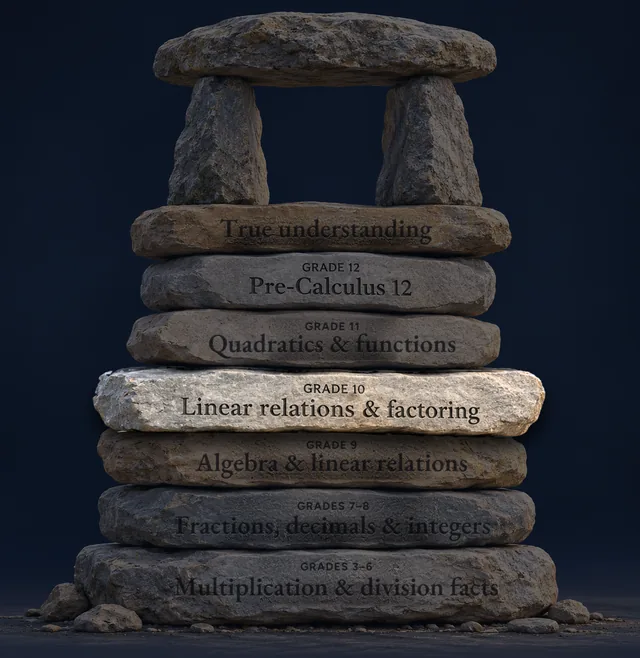
Grade 10 · Foundations of Mathematics and Pre-Calculus 10
Linear relations & factoring
Grade 10 Math is the hinge course. It's the first course where the topics stop being separate: factoring feeds equations, equations feed graphs, and graphs feed everything in Grade 11. It's also the course that decides which math a student takes next, so a weak Grade 10 limits more than one grade.
What students learn in Grade 10
- Prime factorization and powers: GCF and LCM, the exponent laws, and zero and negative exponents
- Polynomials: multiplying binomials, and factoring (common factors, trinomials, difference of squares)
- Relations and functions: domain and range, function notation, reading graphs of real situations
- Linear functions: slope as a rate of change, and the equation of a line in its three forms
- Arithmetic sequences, and how they connect to lines
- Systems of linear equations: graphing, substitution and elimination
- Right-triangle trigonometry: sine, cosine and tangent (SOH CAH TOA)
- Financial literacy: gross and net pay, including CPP and EI deductions
Where students usually get stuck
- Negative exponents: 2⁻³ is 1/8, but a lot of students say −8.
- Factoring vs. expanding: factoring is multiplying run backwards, and students who don't see that guess at factor pairs.
- Slope without meaning: finding "3" without being able to say 3 of what, per what.
- Function notation: reading f(3) = 11 as "x = 11".
- Trig labelling: naming the opposite and adjacent sides from the wrong angle, so the wrong ratio gets used.
What a gap looks like at home
- Factoring homework that takes an hour of trial and error
- Solid on one unit, lost on the next
- "Which method do I use?" on systems or trig questions
- Unsure whether to take Pre-Calculus 11 or Foundations 11
Shows up later as
Quadratics in Grade 11, where factoring is how you solve them, then functions and rational expressions in Grade 12.
How I help
Grade 10 is my strongest course to teach, and I've built a full set of materials for it. I tie every new topic to one the student already has: factoring is checked by multiplying, a sequence is a line with the gaps taken out, a system's answer has to work in both equations. Students stop learning eight separate units and start seeing one subject.