
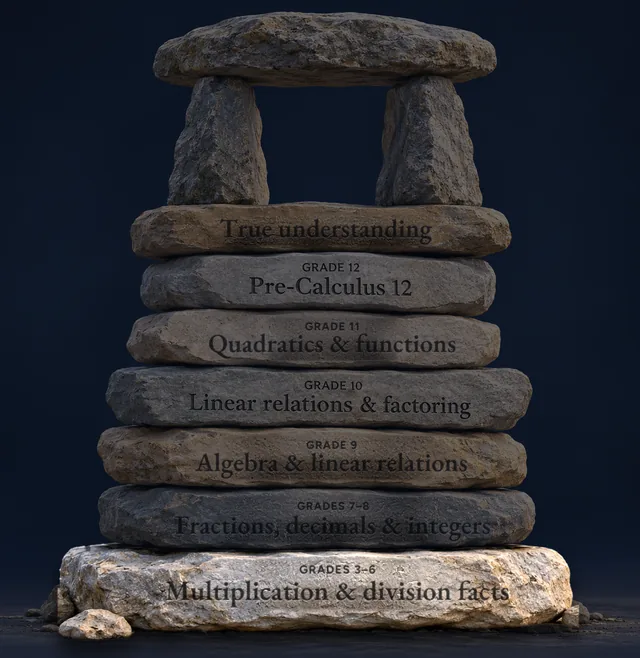
Grades 3–6 · The bottom stone
Multiplication & division facts
Times tables look like the simplest thing in math, and that's why gaps here are easy to miss. A student who still counts up to work out 7 × 8 can get the right answer. But every later topic asks for that answer in a second, in the middle of something harder, and the counting crowds out the thinking.
What students learn in these grades
- What multiplication and division mean: equal groups, arrays, sharing, and how the two undo each other
- The multiplication and division facts to 100, from strategies in Grades 3–4 to quick, reliable recall by Grades 5–6
- Mental strategies: doubling, ×10 then halve, splitting a hard fact into two easy ones
- Multiplying and dividing larger numbers, and what a remainder means
- Factors and multiples: the language that fractions are built on
Where students usually get stuck
- Skip counting from the start every time. "6, 12, 18, 24, 30, 36, 42…" works, but it's slow and one slip ruins the answer.
- The 6s, 7s and 8s. Most students know their 2s, 5s and 10s. The facts in the middle are where recall breaks down.
- Division as a separate subject. A student who doesn't see 56 ÷ 8 as "8 times what is 56?" has twice as much to memorize.
- Long multiplication falling apart, usually because of a place-value slip rather than the facts themselves.
What a gap looks like at home
- Homework takes far longer than it should, even when the answers are right
- Fingers, skip counting or a times-table chart for every fact
- Guessing, or a quick "I don't know", when asked a fact out of order
- Calling themselves "bad at math" while understanding the ideas perfectly well
Shows up later as
Slow, error-prone fractions in Grades 7–8, because finding a common denominator is really finding a common multiple. Then trouble with factoring in Grade 10, which is multiplication facts run backwards: to factor x² + 13x + 42, a student has to see 6 × 7 = 42 instantly.
If your child is in Grades 3–6
I don't tutor the elementary grades. What helps most at this age is a few minutes of practice every day, not a long session once a week. Build the hard facts from easy ones (7 × 8 is 7 × 4, doubled), and practise division alongside multiplication so it's one set of facts, not two.
If your child is older and this stone is still shaky
This is where I come in. I often find slow multiplication facts underneath a Grade 8, 9 or 10 student's trouble with fractions or factoring. I find which facts are solid and which are being guessed, rebuild the shaky ones from the solid ones, and send home a few minutes of daily practice, all alongside their current course so they don't fall behind while we fix it.
Practise this stone
(for students in Grade 7 and up)