Grades 7–8 · Math 7 and Math 8
Fractions, decimals & integers
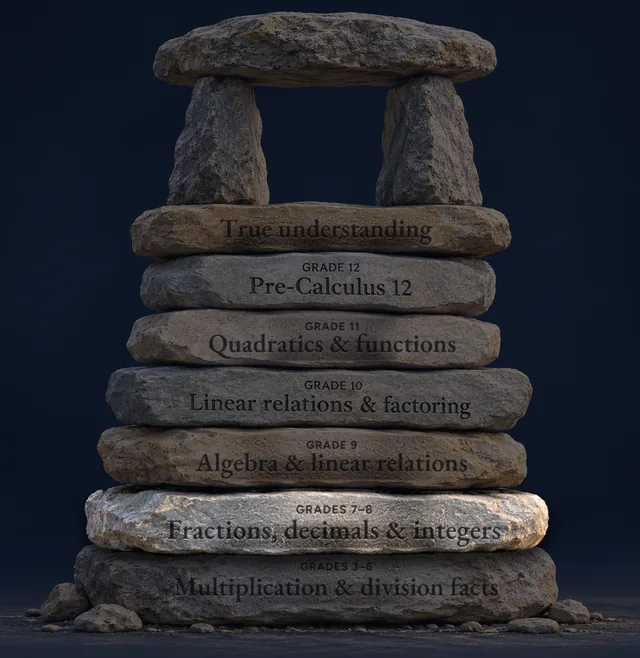
Grades 7 and 8 are where numbers stop being whole. Negative numbers, fractions, decimals and percents all arrive at once, and each comes with rules that are easy to memorize and easy to mix up. A student who leaves Grade 8 unsure about these is often fine in Grade 9 algebra. Then the algebra gets harder, and these stop being separate topics and become the material everything is made of.
What students learn in these grades
- Integers: adding, subtracting, multiplying and dividing negative numbers, and the order of operations
- Fractions: all four operations, including mixed numbers
- Decimals and percents: converting between fractions, decimals, ratios and percents, and percents below 1% and above 100%
- Ratios, rates and proportions: unit prices, best buys, scaling a recipe
- Money math: sales tax, tips, discounts and sale prices
- Squares, square roots and the Pythagorean theorem
- Two-step equations, such as 3x + 4 = 16
- Linear relations: patterns written as expressions, tables and graphs
- Measurement and data: circles, surface area and volume, circle graphs, probability
Where students usually get stuck
- Adding fractions across: writing 1/2 + 1/3 = 2/5. It looks reasonable, and it's wrong.
- Subtracting a negative: 9 − (−4) is 13, but "minus a minus" is often treated as a rule to remember rather than something that makes sense.
- "Two negatives make a positive" used everywhere, including in addition, where it isn't true.
- Dividing fractions: "flip the second one" without knowing why, so they flip the wrong one.
- Percents over 100: an increase of 122% feels impossible to many students.
What a gap looks like at home
- Reaching for the calculator for fraction questions that don't need it
- Getting the sign wrong on an answer that's otherwise correct
- "Is it multiply or divide?" on almost every percent or rate question
- Doing well on a unit test, then losing it a month later
Shows up later as
Sign errors when solving equations, confusion about slope (slope is a fraction), and rational expressions in Grades 11–12, which are fraction rules with letters in place of numbers.
How I help
I rebuild the rules from pictures before going back to the rules: two-colour counters for integers, bar models for fractions. A student who has seen why 3/4 ÷ 1/8 asks "how many eighths fit into three quarters" never has to guess which fraction to flip. Then we practise on their actual homework, so the fix shows up in class right away.